

 Wersja niemiecka / Deutsche Version
Triptych of St. Maximilian
On the right side of our church there is a triptych painted in 1998 by Piotr (Peter) Moskal from Kraków. It is dedicated to St. Maximilian's internment in the Auschwitz concentration camp. Under the triptych, in the wall, there is an urn containing the ashes of murdered prisoners and a stone plaque listing the names of the countries from which the prisoners came.
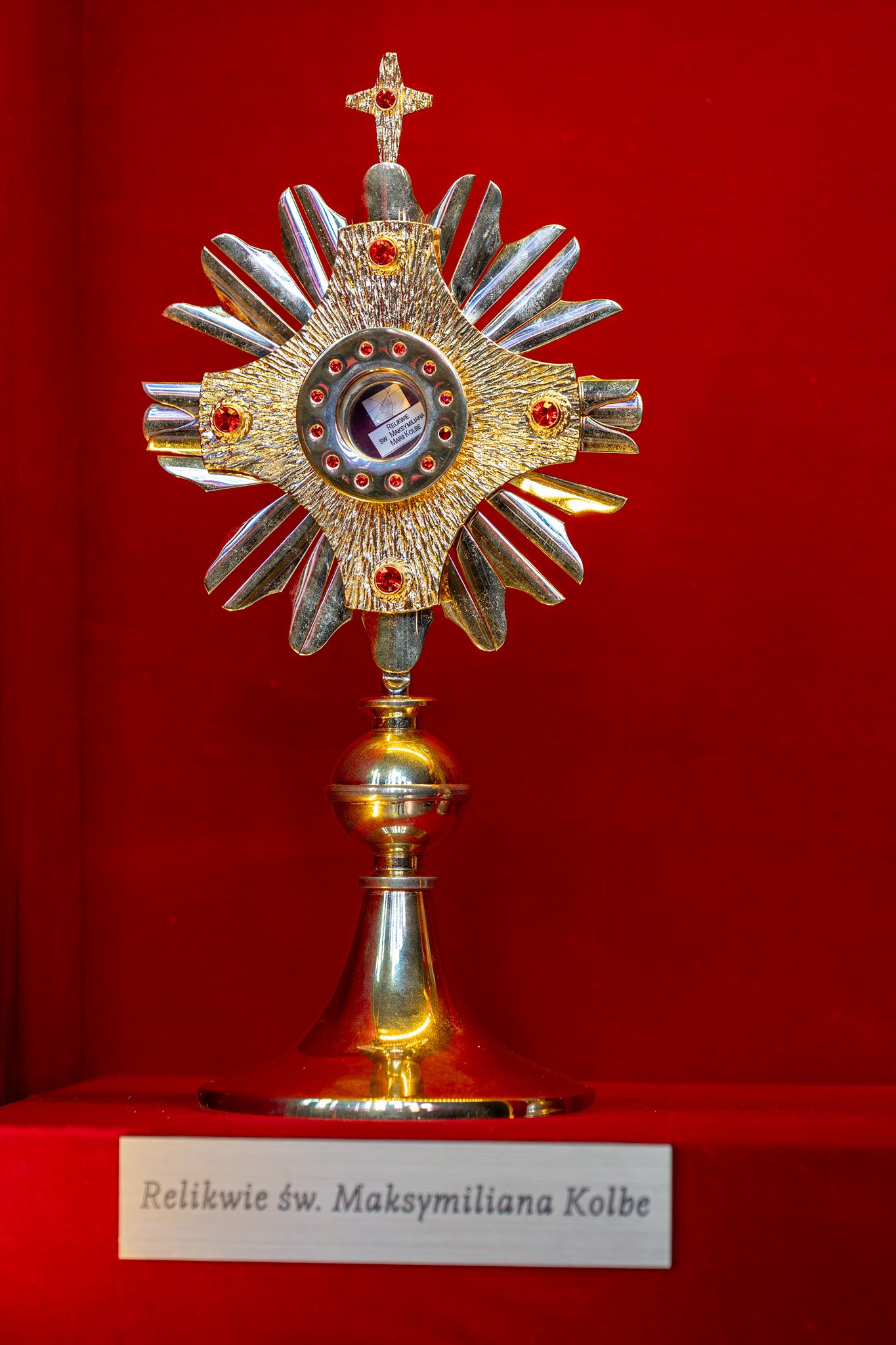
The relics of St. Maximilian
Relics are mementos left behind by saints. They are fragments of their bodies (direct relics) or objects they used (called indirect relics).
A hair from St. Maximilian's beard
The only direct relics of St. Maximilian that have undergone DNA testing are hairs from his beard, which were secured before World War II. At the beginning of World War II, when the Gestapo began searching Polish monasteries for Jews in hiding, the Franciscans at Niepokalanów decided to shave their beards. Among them was Father Kolbe. The monastery barber kept a lock of Maximilian's beard as a souvenir which became a relic and is now reserved with utmost reverence in Pabianice.
Father Maximilian's body was burned in the crematorium at Auschwitz. It is not known what happened to his ashes. The Germans took the crematorium ashes to farmland, threw them into ponds, pits, excavations, and even into the rivers flowing near the camp: the Soła and the Vistula.
Thanks to the efforts of the priests working in our parish, some relics were brought from Niepokalanów to our church. The veneration of these relics in our parish - every Thursday throughout the year during the perpetual novena in honor of St. Maximilian and during diocesan and parish celebrations on August 14 - is an expression of respect for the saint and a request for his intercession in the prayers offered by the faithful.
St. Maximilian's Rosary
The second memento of Father Maximilian is a piece of his rosary, kept in a glass box held in the hand of a statue of Mary Immaculate. The rosary was kept by Wilhelm Żelazny, a resident of Chorzów. He was sent to the camp as a teenager for his underground activities. There he fell victim to one of the SS men - the German knocked him to the ground and trampled on his chest until he broke the boy's ribs. In serious condition, he was taken to the camp hospital in block 28. After weeks in serious condition Mr. Żelazny was close to death and in great despair wanted to throw himself onto the live wires. He was dying when Father Maximilian came to him. He heard his confession and comforted him, and at one point reached into the pocket sewn under the armpit of his striped uniform and took out a piece of a rosary. "You are young, you will surely survive. Take this as a souvenir and pray on it every day," said Father Maximilian. Żelazny survived.
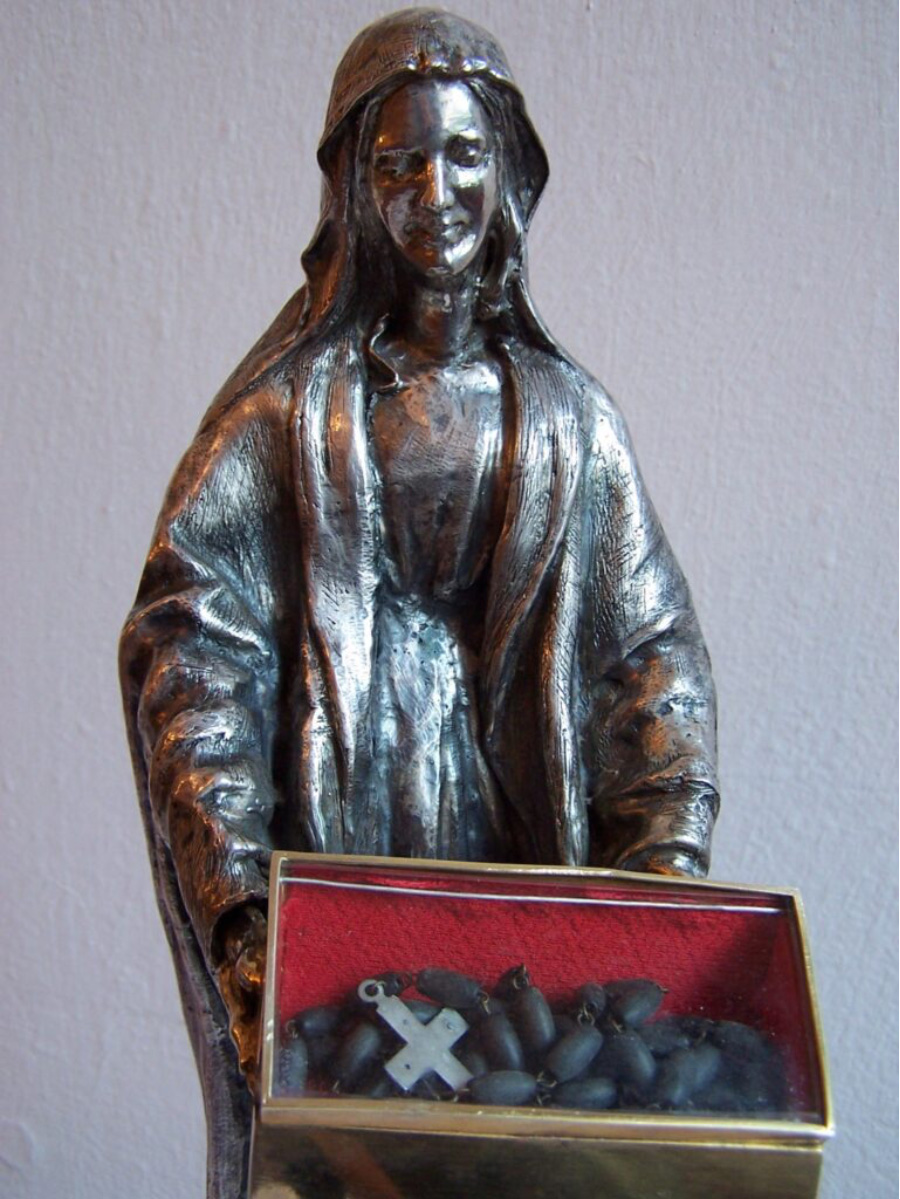
Father Maximilian who had been deported to Auschwitz as a political prisoner was well known by Mr. Wilhelm Żelazny, prisoner number 1126 at the Auschwitz concentration camp. According to Mr. Żelazny’s sworn eyewitness testimony, Father Maximilian told the prisoners the following story of this rosary. In February 1941 Father Maximilian was sent to the Pawiak prison where an SS officer beat him on the cheeks with the rosary, held it under his nose and forced him to smell it, then threw it on the ground and trampled on it, while beating and kicking Father Maximilian. Father Maximilian replaced the missing beads with threads pulled from his habit. After regaining his health, Mr. Żelazny was transported to Katowice and then taken to work in Germany. Later, through France and Italy he joined General Anders' army and returned to Poland with part of the army. He kept Maximilian's rosary as his most precious possession. After the war, he was under the surveillance of the Communist political police (SB), so the rosary along with other mementos from the occupation, was kept in Katowice at the home of Bishop Bednorz's sister. Mr. Wilhelm Żelazny donated Father Maximilian's rosary to St. Maximilian's Church in Oświęcim on September 10, 1989.
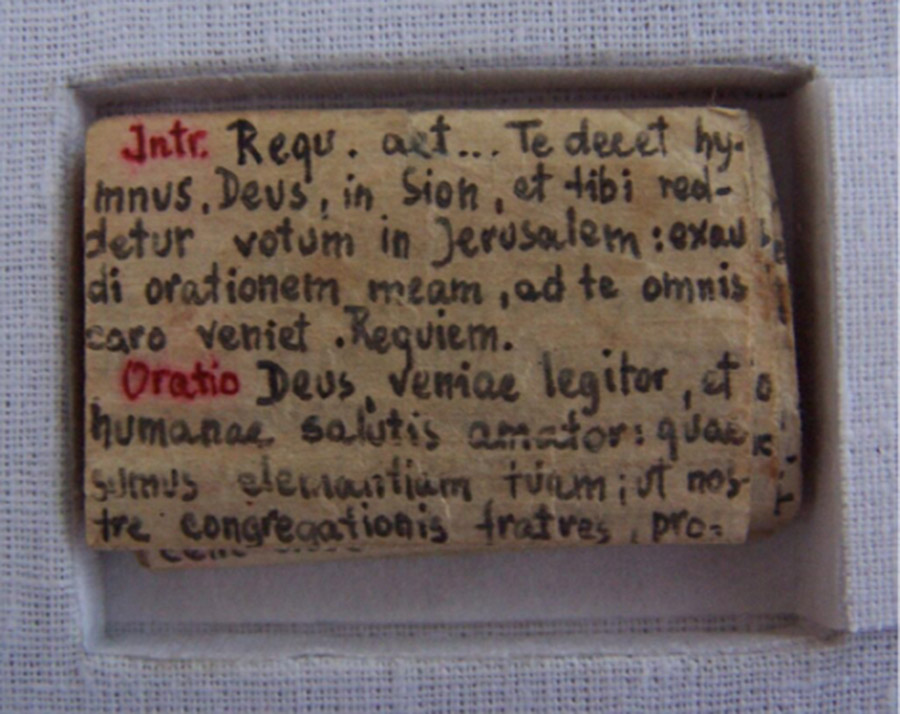
Camp missal
It is associated with a thick, heavy book containing prayers used during Holy Mass. However, this missal is different. The reliquary is a small box, the size of an old tea box, made of thick copper sheet metal. A cross and the inscription "From the Auschwitz-Birkenau extermination camp 1940-1945" are embossed on the lid. The reliquary can be opened. Two brass screws are unscrewed and the lid of the box opens. The interior is lined with white linen. In the center, there is a small recess measuring 3 by 4 cm. Under a celluloid cover is Father Maximilian's missal. It is not a book, but a secret note: a strip of paper slightly over 3 cm wide and about 20 cm long, folded like an accordion, filled with careful handwriting on both sides, from edge to edge. The letters are even, calligraphic, red and navy blue. The note contains the Latin form of the Mass for the Dead, "De Profundis." These are: antiphons, prayers, readings, the preface, and the canon – a complete set of texts needed to celebrate the Eucharist in the pre-conciliar rite. The missal resembles a school cheat sheet. It was designed to be easily hidden. Its author is unknown. It can be assumed that it was prepared outside the camp and miraculously smuggled into the camp.
Camp chalice
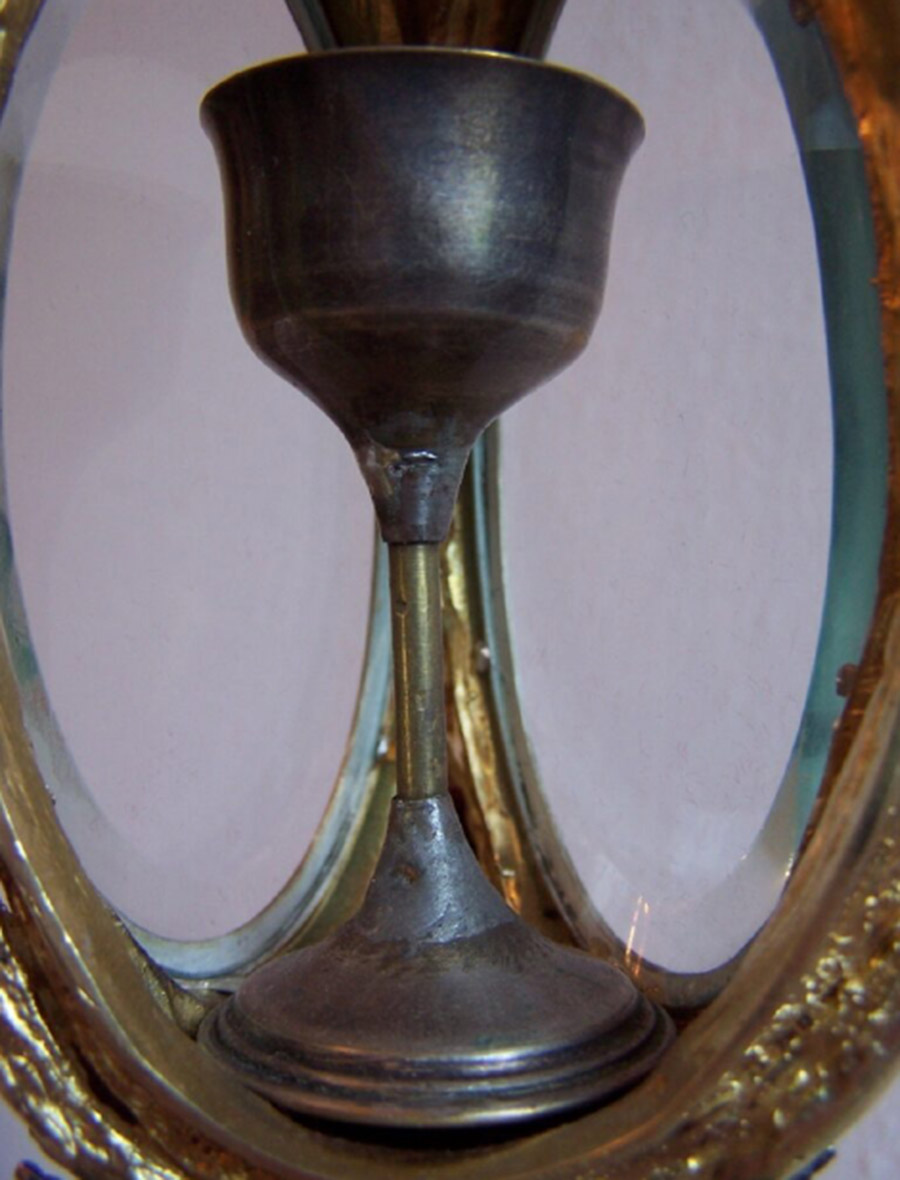
An impressive reliquary made of brass and steel – two silhouettes of emaciated people in camp stripes with their arms stretched upwards hold a glass lantern containing the chalice. Unlike customary liturgical vessels, the camp chalice was made of sheet metal. It is a faithful copy, a miniature of a liturgical chalice – about 7 cm high and less than 3 cm in diameter. Its individual parts – the cup, stem, and base – can be taken apart and hidden separately.
Father Maximilian used the chalice and paten for Holy Mass, which he celebrated secretly in the basement of block 25A. These items were recognized and their authenticity confirmed by Father Kolbe's fellow prisoner, Father Konrad Szweda, who survived the camp's ordeal.
Mr. Franciszek Ptasznik born on August 20, 1910 in Michałkowice near Cieszyn, was a civilian employee of the German company Kluge, which was involved in the construction of barracks in the camp, and then a camp prisoner with the number E-3021. As punishment for breaking German discipline, i.e. for talking to a prisoner during work and leaving the barracks he was sentenced to three months of imprisonment in block 25A where prisoners met for communal prayers. There priests secretly celebrated Mass in the basement. One evening, Fr. Studlik (who was the secretary of Archbishop Sapieha), expecting to be transported to KL Dachau, asked that small church items – a metal (silver) chalice consisting of two parts, a standing cross, a tiny book, and a stole – be taken out of the camp and brought to Fr. Józef Bylica from Włosienica.. Every day Franciszek Ptasznik carried out one item in his trouser leg. Finally, he bundled all the items in packaging left over from sugar and took them to the Pastor in Włosienica. Fearing a search of the rectory, Father Józef Bylica threw the package behind the tiled stove in the office. After the war, Father Bylica displayed these relics during church services in Włosienica.
Monsignor Jan Skarbek from Oświęcim, having learned about these items, received them from Father Bylica. Later, when the construction of the Church of St. Maximilian the Martyr began, thanks to the efforts of Bishop Kazimierz Górny, these relics were transferred to our parish. Mr. Ptasznik lived to see the liberation of the camp. After the war, he worked in a tobacco factory and lived in Oświęcim (in our parish) at 1 Kusocińskiego Street.


